Friday, February 18, 2011

Are We Due For A Market Correction?

1 Year TSX Index - daily prices (Click to Enlarge)
The chart shown is a daily price chart of the Toronto Stock Exchange for the past year.  We have been following along a nicely defined channel during that time.  It presents an almost classic Elliott Wave 5-wave pattern.  The convergence of the upper channel line, the price candles, and last trend line all suggest we should be very close to a top.  Looking at a chart of the S&P500 Index, I get a very similar result.

It is too early, yet, to tell if 20 year U.S. Treasury bonds are making a bottom (if only for the time being).  We are seeing a second week of gains for them after closing in on an almost three year trend line.  Earlier I blogged about the bounce in the commodities index.  It has now been going sideways for a couple of weeks.

It is impossible to call the exact top.  If anyone could do that, they would be more famous than Warren Buffet.  The point is, the likelihood of a correction in the market at this point, is greater than that of the market duplicating last year's performance without, first, correcting (despite any and all quantitative easing).  We never know what event will trigger a sell-off, but something will come along, people will perceive it as negative, and down goes the market.  Buy-and-holders won't care - they won't be happy, but they'll wait it out.  Me, I have already taken my profits.  I don't trust the markets to go much higher, so I am preparing for the correction.

As for the cause of market tops, I don't want to imply they are caused by certain events.  The real cause is the lack of new money being put into the markets.  A top comes when everybody who wants to get in has done so.  Buying dries up.  It is rather like trying to inflate a balloon with a hole in it.  As long as the amount of air going in exceeds the amount of air leaking out, the balloon will grow larger.  Stop putting in air, and the leak will cause the balloon to deflate.  Of course, if the leak grows larger, then the balloon deflates even faster. 

I am not a professional, and I can not give you advice, but as I said, I feel this is a good time for me to protect some of my gains.  I'm just saying!

Do you feel we are due for a correction?  Have you taken any profits?

P.S. The basic timing model I blogged about earlier wouldn't currently give us a sell signal until the market has corrected by almost 10 percent.  Where it would make us money is in the large corrections we see every 4 or 5 years, or so.

Wednesday, February 16, 2011

The Merger of the Toronto and London Stock Exchanges

Hunting dogs never follow the pack.  You will always find them running along ahead of the group.  At a fork in the road, they will pursue whichever fork attracts their attention.  Should the hunters take the other path, the dogs will scramble through the brush until they are, once again, leading the pack.

Sound familiar?  Sound like any politicians we might know?  I had blogged previously about the potential costs from the government blocking the Potash take over.  Since the politicians saw nothing wrong with what they did the last time around, they are about to put their foot in it again.  Up to this point there are few popular political points to be had either way.  If there are any, they would be found in protecting Canadian financial services and Canadian jobs (in the short term).  The Canadian banks are hardly going to support more competition for their newly formed Alpha exchange.  Oh, remember the reason for creating Alpha in the first place was to provide competition for the Toronto Stock Exchange (TSX).

I find it interesting how the politicians were against the Potash take over, as was the electorate, at large.  The same government was in favour of competition in the mobile telephone sector despite uncertain foreign investment rules (as was the electorate).  Now, I doubt the merger of the TSX and the LSE will happen because there are few, if any, votes to be won by making it happen.  How's that for consistency (especially the vote getting part)?

So why should we, as investors care?

Let me start by pointing out the aversion business has to government interference and tax grabs.  We have a unique opportunity in the post financial crisis period to create a stable environment in which to attract foreign capital and business.  The result would be more growth, more jobs, perhaps even a more diversified Canadian economy.  Governments that focus on vote-getting and tax grabs do little to inspire businesses to make large capital investments.

Are we really in such denial that we think Canada is such a great place to work and play (which it is) that businesses will just ignore how difficult it is to navigate all the red tape and, in the end, be subject to the whims of politicians at the local, provincial, and federal levels?  I laughed out loud when everyone was quick to point out how protectionist our fellow Americans were, when it was our own provincial trade barriers which were the real reasons they didn't want to relax their constraints.  We wanted to be able to play in their back yard as long as they weren't allowed to play in ours!

Our banking system is seen as being one of the best in the world.  One could make the argument that it is our rules and regulations that got us to this point.  I might point out that the amount and type of regulation is irrelevant when governments just make up the rules as they go.  How many foreign investors did Canada lose with the change in the Income Trust rules?  How many because of the increase in Alberta oil royalties?  How many because of the Potash deal?  How many if we stop this merger of stock exchanges?

Two things are abundantly clear.  First, we need to define, then follow, the rules we expect investors to abide by so they don't feel they are being ambushed all of the time.  Then, we need one (national) regulator to enforce those rules.  While we are at it, why don't we give that same regulator the power to protect you and me and our fellow investors from ponzi schemes, corporate crime (think Bre-X) and the like.

As for me, I am tired of all the fighting between different levels of government, and self-serving agencies, especially the all-talk and no-action part.  I am even more fed up (pun intended!) with governments which rely on the absence of clear regulation to twist events into situations for vote-getting.  While it guarantees them a job and furthers their pension, it is costing you and I real money, money which comes out of our own investment funds, and pension funds.

How do you feel?  Are you in favour of the merger between the TSX and LSE?  What about having a national regulator?

Thursday, February 10, 2011

Toyota. Buy, Buy, Buy!

Tuesday was a very sad day for me.  I have to admit I had started to believe that Toyota was just like any other huge corporation that had lost its way.   The lure to become, and remain number one in the auto industry was too much for them.  They had lost touch with customers, and worse still, they had put profits ahead of the safety, and lives of customers.

While I was suspicious of the media, and the agendas of the U.S. politicians, not to mention those of the U.S. auto industry, I never, for a moment believed that such unprecedented numbers of every-day people would misrepresent the difficulties they were having with their family automobile.  Now, I understood many, many people were walking away from home mortgages, but that seemed to me like a case of, "I can't pay what I don't have."  In the case of Toyota, they were actually blaming the car maker.  In addition, they were, and are, demanding compensation for problems which were, largely, not the fault of Toyota.

The National Aeronautics and Space Administration (NASA) has studied the problem and in every case, any difficulty caused by sudden acceleration would have caused the engine light to come on.  Only a handful of such cases exist according to the NASA studies.

Once again, we have to wonder what role the media has played in all of this.  As for our own media, the CBC in particular, I was sickened, when on that very same Tuesday, they chose to show the execution of one of the Egyptian protesters by, what appeared to be, the Egyptian police.  Is there not enough violence in this world already?  Is it any less violent to show such an act on national television than to commit the crime in the first place?  Are they trying to incite even more violence?  Do they feel they must go to these lengths to gain viewers?  Personally, in future, I will get my news from the internet, thankyou, CBC.  Just when I think people can't act any dumber...  Perhaps they have been watching their own newscasts for too long.

Having said all that, the thing that sticks in my memory about Toyota's difficulties is the chairperson of Toyota offering his sincere personal apology for not having listened to customers better!  Now this is the type of company I would be interested in.  Management plays a huge role in successful companies.  I can only contrast this with the likes of Firestone.  Firestone knew their tires were defective and that tire failures would result in people dying, but deemed it more cost effective to continue with production.  There were also other tire companies whose products I will never in my life-time buy again.  How's that for cost effective?  And, if I wouldn't buy their products, I'm not about to buy their stock.

The same goes for the likes of cigarette companies, or asbestos companies.  I know there are people in the media (and outside, for that matter), who believe the ends justify the means.  How can we invest in cigarette companies without condoning the sale of poison to people under the guise of free choice?  What type of greedy, mostly self-centred people should we think run those companies?  Do we really think they care about treating employees and shareholders fairly when they are prepared to poison their very own customers?  What about what it is costing you and I in health care expenses?  Should we feel that we can trust these people on any level?

For the free, capitalist system to work, we should reward the best companies that are able to achieve their greatness while upholding their ethical standards.  The only result of rewarding those who cheat and lie is more cheaters and more liers, especially when they are granted special status like "too big to fail".  I would rather make less money investing in honest and trustworthy companies and maintain my own integrity.  It isn't like I can buy it back again with the extra money I might otherwise make.  I say fire the politicians and bankers who created our current financial crisis, and stick with companies who have proven they can be trusted to be profitable while remaining fair, ethical and uncompromising - companies, as it turns out, like Toyota.

Do you believe the end justifies any means of obtaining it?  Why?

Tuesday, February 8, 2011

U.S. Unemployment Drops to 9.0 Percent!

I had to smile at the reactions to the non-farm payroll report on Friday.  While the U.S. economy added a lot fewer jobs than expected - well below the rate needed to accommodate new entries into the job market - the official unemployment rate dropped from 9.4 percent to 9.0 percent.  Apparently adjusting the numbers for seasonality includes factoring in the weather, of all things.

I have a suggestion.  Why don't we just say the unemployment rate is 4.0 percent, except for the people who are out of work because of the last recession?  Why spend time and money actually calling people, when we can just tell people what we want them to hear.  Perhaps we should try that with earnings estimates.  "We will stick with the numbers in our quarterly forecast as we would have met them had it not been for the case sales were lower than expected."  How about sporting events?  We can just give the better team a higher score since, normally, they would have won anyway.

My question is, at what point does massaging the numbers turn into rationalization, then denial?  I just heard Mr. Bernanke say U.S. economic policy was forcing fixed income investors to turn to "alternative" investments, but, no, that would not include commodities.  I understand the need to project positivity and hope, but we need to make financial decisions based on real facts.  There is real danger in fitting the facts to correspond to our outlook.

That is the takeaway to today's post.  Putting money into these volatile markets requires that we observe what is happening with an open mind, and protect our money accordingly.  We need to learn what to look for and have the discipline to act on that information.

Don't be misled by the propaganda of the day.  There is a world of market participants who are just waiting to take the money of people who do not have both, the discipline, and a system to protect them from their own emotions.  I even fear for the buy-and-holders when this commodity bubble bursts.  As hard as it is to watch the market go higher without me, I am not about to put new money into the current markets, expecting them to go much higher from here.  In my own case, I expect it will take a substantial correction in the indexes before conditions improve that much.

What about you?  Do you see opportunities in these markets?

Friday, February 4, 2011

The Effects of Qualitative Easing

Click To Enlarge
I hadn't decided what this post should be about as I watched Mr. Bernanke say he did not feel rising commodity prices were being caused by U.S. monetary policy.  His take is higher prices result from too much growth in the developing countries.  He did admit that Qualitative Easing Round 2 was causing fixed income investors to look to "alternative" investments since yields were historically low.  (Just not commodities, I suppose).
 
Then came the story that commodity traders were making a huge bet on Thursday against base materials  - copper, lead, etc..  

Then I remembered a recent conversation I had regarding when the U.S. might have to ease up on what they are doing before riots the likes of Egypt started breaking out all over the place.

My point is, whenever the government starts to mess with the markets, it always, always, always, ends badly.  Do they not remember the cause of the financial crisis the world is, even now, trying to recover from?  As a kid, I think the expression was, "Two wrongs never make a right!"

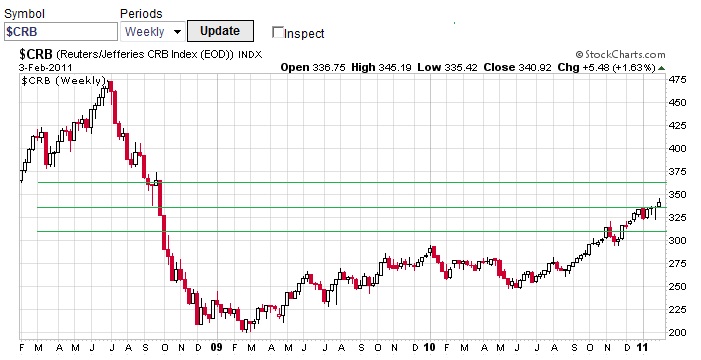
I blogged a few days ago how I don't believe in forecasts, so while I cannot predict with any accuracy when it will happen, we can know from history that it will happen.  The chart above shows us the CRB Index.  It is an index which reflects the movement of global commodity prices.  The green lines I have drawn on the chart reflect the normal retracement levels for a typical correction.  Like dropping a golf ball, or a basketball, or any rubber ball, the bounce is somewhat predictable.  Does that mean the index can't go higher than the highest green line?  No, but probability says that it normally won't.  You can see why traders are preparing for a reversal in commodity prices.

There are a couple of reasons why that might not happen.  First, the government stimulus may not have run its course, as yet.  Mr. Bernanke did not rule out the possibility of QE3 in his presentation.  Personally, I don't think they know what else to do.  Secondly, we are in the middle of the period of time when materials, metals, and mining tend to do their seasonal best.  The third reason would be what I said about things ending badly.  We are close to the point when we would expect a reversal.  The longer the prices run up, the worse the result, both to the world economy, and to the eventual crash.

I can hear it all now.  Once QEn (where n equals infinity) no longer has a stimulative effect and things come crashing down around our ears, the best and brightest minds(?) on the planet will tell the cameras with completely straight faces, that despite riots in the streets protesting the unaffordability of food and fuel, nobody knew a crash might happen!  Sound familiar?

I'm not trying to scare anyone out of the market, but I am suggesting a great deal of caution out there!    

Thursday, February 3, 2011

Portfolio Update

I am not a financial advisor, nor do I hold any designations within the financial services industry except one.  While working in the life insurance industry I did obtain the designation of Fellow of the Life Management Institute (FLMI) which means I have passed a series of exams relating to the life insurance industry.

My story is similar to the fisherman who lived in a small shack located in a tropical paradise. He would take people who knew little, if anything about fishing on guided tours of the best fishing spots.  On one such occasion, one of those people asked him why he didn't borrow some money and buy more fishing boats?
"Oh, and then what?" the fisherman asked. 
"Well, you could grow the size of your company and make lots of money," the other said.
"Oh, so then what?" asked the fisherman. 
The person said to him, "You could buy a bigger house, faster boats, and save for your retirement." 
Again, "Oh, so then what?" asked the fisherman. 
"When you are ready to retire," the other said, "you can sell your company, buy your dream home, move there, and live happily ever after!" 
"But," protested the fisherman, "That is what I already have!"

I understand having various industry designations would give me more credibility with people who don't already know me, but I remain unconvinced they would make me better at what I do.  Personally, I believe most "how to" advice regarding stock markets is, largely, marketing advice.  I don't want lessons in marketing. I want to help others who are interested in having more money.  Since I am not legally qualified to do so, rather than offer stock picks, I will reveal my methods and returns so others can decide whether, or not, I do have any credibility.  I will help those I can, and not worry about the fact others will reject (and criticize) my ideas.

Indeed, I welcome constructive criticism.  The quickest way to improve is by learning from the experience of others.  Although I have learned much over many years, I look forward to the thrill of future discovery.

I am not a day-trader, nor am I an advocate for buy-and-hold.  With that in mind, I will post monthly portfolio updates.  Earlier I wrote about setting aside an amount to be invested in the name of charity.  That amount is determined by the returns on my advanced market timing model.  I will also update the returns of the basic timing model (seen here) .

One month return for TSX @ Jan. 31, 2011 = 1.01 percent
One month return for Basic Timing Model using XIU = 1.5 percent
One month return for Advanced Timing Model (my returns) = 4.1 percent
Money for charity = $411.27

Tuesday, February 1, 2011

What Are ETF's?

ETF stands for Exchange Traded Fund.  When I wrote about my basic market timing model, I mentioned the purchase of an ETF which tracked the total stock market rather than a mutual fund.  Before I talk about ETF's I would like to talk, first, about the problems I have with mutual funds.

Most mutual funds are actively managed, where a fund manager decides what to include in the fund according to the prospectus which defines the types of investments to be held.  There are equity mutual funds, fixed income mutual funds, and money market mutual funds.  Many have sales fees, either when I buy, or when I sell.  They charge a management fee, and deduct certain costs from the returns they generate.  Mutual funds pay a commission to the person who sold me the fund.  While there are a couple of good reasons to buy a mutual fund, generally, the cost of doing so is the reason I am not a fan.  Just to be clear, I am not a financial advisor, or anything of the sort, either.  In a case of I can buy better, but I can't pay more, most funds, because of the expenses involved tend to under perform the market.  One's that outperform rarely do so for long periods of time.  Guessing which mutual fund to own is a bit of a mug's game.

ETF's, on the other hand, tend to mirror a particular index, or commodity.  Since there is usually nobody picking what to include and what not to (that has already been determined by the index), the charges to me for fund management are less.  What that also means is when the index goes lower, so does the ETF, by an equal amount.  There is nobody trying to slow the decline.

They are called exchange traded funds because the shares trade on a stock exchange in the same fashion as other stock equities.  When I buy shares in the fund, I pay a commission fee, instead of a sales charge.  The management expenses are deducted prior to the share's value being determined.  If my shares go up ten cents each, then that means I made ten cents after the fund company has taken their portion.

There is a difference between regular shares and ETF shares.  With regular shares I purchase shares in one company at a time.  With ETF's I buy a basket of shares (of whatever makes up the underlying index), or contracts based on commodities.  A few ETF's allow me to buy the actual underlying commodity itself, with the fund manager having to store it for me.

Another difference is one of supply and demand.  A company offers a number of shares in the company to raise money.  ETF's are bought and sold from a float which is for most purposes, practically limitless.  I do not need to be overly concerned with supply and demand, as those constraints apply to the price of the underlying index, or commodity.

For people who have not heard about ETF's from a financial advisor, it is likely because advisors do not make any money when recommending the purchase of an ETF.  They do when selling mutual funds, but not for ETF's.  Since they trade like stocks, purchasing ETF's is seen to be more for the sophisticated investor, and less so for the beginner.  To avoid full service brokerage fees, I also need my own discount brokerage account online.

When starting out, I looked at purchasing widely based ETF's which performed as closely to the actual TSX as possible.  Sector, and specialty funds came later only after I gained more experience.  Claymore, Ishares, Horizons, as well as many of the Canadian banks have ETF's which are bench marked to the TSX.

Again, learning to manage my own funds took a little time and effort, so I started by "paper" trading without plunking down any actual money, and then started very, very small.  By small, I mean no leveraged ETF's - ETF's that return a multiple of the underlying index (i.e.: two times, or three times) until I gained some experience and understood what they were and how they worked.

I can make more by earning higher returns from my investments, or better still, by simply avoiding many expensive mutual funds.