Tuesday, July 31, 2012

Evil Corporations, Or Corporate Evil?

The Root Of All Evil
An acquaintance of mine believes that the corporation is the root of all that is evil in this world.  Personally, I don't believe corporations are any more evil than nuclear power is.  By that, I mean to say that nuclear weapons are a misuse of nuclear power.  Nuclear power, like the corporation, is not bad in itself.  Whether corporations are good or bad for society depends on the people within those companies.  To say that corporations have no conscience, is to see them only as legal entities.

Life and Death?
Despite all of the hype and war-related allegories, business is not war.  It can be a struggle, but very seldom is somebody literally holding a gun to one's head.  Terrible things happen in war because of the fierce struggle between life and death.  The death of a company is the death of a legal entity.  Sure, real people lose their jobs when a company ceases to exist, but to compare that to people being killed, is, at the very least, an extreme comparison.

Profits
To say the profit motive is the reason "companies" misbehave, is to excuse the behaviour of the people running the company.  Why not just assess a fine to the company for wrong-doing?  Again, to hold the company accountable for the actions of people within it, only shields those people and allows for such bad behaviour in the future.  Worse yet, it passes the real costs onto shareholders (which is why we don't want to invest in such organizations).  Yet, time and time again, I hear the talking heads in the media recommending an investment in so-called sin stocks, for example.  Take the profits and give some to charity, they say.

Trust
I believe in the saying, "If they will do it with you, they will do it to you!"  Apart from the fact nobody is holding the bad guys accountable, these days, I don't understand why companies fail to see the benefit of acting in an ethical manner, and why the media and analysts excuse any such bad behaviour.  Stephen Covey Jr. wrote a whole book on the concept of how much easier (and less expensive) it is to transact business in an atmosphere of trust.  When people don't trust you to do things in their best interest, they tend to need more convincing, and bigger guarantees (and more lawyers).  If people representing a company have no difficulty selling a product which is dangerous to its clients, how much more regard do you think they will have for outside investors?

By The Numbers
Just for giggles, I checked out the curriculum of a popular MBA (Masters in Business Administration) program.  While it talks about learning how to maximize or minimize everything and anything business related, it failed to mention a single topic which might be seen as ethics related.  This further contributes to my belief that business, these days, is thought to be about the numbers, and nothing to do with ensuring an atmosphere of trust within which all acts of commerce would benefit.

Those Days Are Numbered
Again, I just don't understand what they are thinking.  Any entrepreneur will tell us we can only ever expect to do business with the people who actually trust us.  Have corporate business people never heard of word-of-mouth, and social media (which I have heard described as word-of-mouth on steroids)!  The idea that there is a sucker born every minute may even be true, but no company can afford to be seen acting on such a belief in today's world.  How long or well would Toyota have survived the recent bashing they received had it not been for the integrity of senior management, and their putting customers first?  The "old boy" network is dying out.  As long as there are other companies willing to remain loyal to the old way of doing things, they will be able to find buyers for whatever they are selling, but those days are going to end soon enough.

Return On Investment
As for the banksters?  They will continue to hide out within and behind their organizations until regulators and customers hold them accountable.  Yet, that day, too, will come.  I suppose they think, until then, who cares?  I say, use and invest in the companies run by people that aren't just trying to stuff their own pockets.  As in the case of Toyota it is clear that integrity is, in fact, economical in ways that can't be achieved by adopting less than ethical approaches.  While I think of it, maybe somebody should let the MBA students in on that well kept secret!  

Do you have an opinion as to whether or not you think corporations are evil?


Wednesday, July 25, 2012

Expectations

Wide Open
Part of the reason for my fewer than normal updates lately has been my visit to western Canada for my son's wedding.  It is always a great joy for me to meet people there.  For a guy that lives in Southwestern Ontario, and spends a certain amount of time in Toronto, I am simply overwhelmed by the openness, and friendliness of western Canadians.  

Family
I suppose it is because the region where I was visiting is more rural, as a whole, that I seemed to find more people who work for a living rather than living to work (although not, perhaps if I was to spend time at Fort McMurray!).  Probably because of the wedding, there was a large emphasis on family, especially on their part.  People came from far and wide out there to attend the wedding, while few from my family in Ontario could interrupt their busy schedules.

Old Theme
While there, I found myself engaged in a particular conversation over and over again.  I may not notice something if it happens only a couple of times, but several times within a few days I found myself discussing the expectations of people, and how those expectations seem to have changed over the last number of years.  The actual conversations took different form, and involved different people, but each time the theme was the same.  That theme was, in short, immediate gratification.

The Lost Art
Whether it was the store owner, the retired worker, the corporate adviser, or simply, parents, I was surprised when the same theme kept coming up.  In each case, I found myself discussing the seeming loss by people to see any benefit in "paying their dues" or adopting a longer term approach as a means of achieving their goals.

Debt
We also see much of this in the media these days.  Apparently we taught our children everything we know.  The willingness of people to accept debt in order to get what they want today is what resulted in the last Great Recession.  Credit, in itself, is not so bad, but neither is saving first, before making a purchase.  I come from a humble family, and growing up, the family home was the only thing we purchased on credit.  If I wanted to buy anything, I had to save, not just ten, or twenty percent of the purchase price, I had to have an amount of cash equivalent to the total.  Think how much money I saved myself in interest payments!       

No Worries?
What I learned growing up was how to live within my means.  We need to budget not just for our expenses, but for our savings, as well.  Most people I talk to have very little in investments, other than the family home.  "No money!", they say.  Imagine if they took all of the money they have already paid in interest and could use that to create an investment account!  Most people point to their credit card when I ask if they have an emergency account.  No wonder Mark Carney of the Central Bank is so worried about household debt levels in Canada.   

A Line In The Sand
I understand the Banksters have done everything they can to get us into as much debt as possible, and how easy and harmless it is made to seem when it comes to not paying off that credit card balance at the end of the month.  Yet, there comes a point when one must draw a line in the sand.  If we are smart, that line is a whole lot less than our total income.  Understand that the world is currently in a deleveraging cycle which could last for a decade, or more.  Everyone is going to be demanding a larger share of our wallet.  We need to ask ourselves where that money is going to come from.

As for my son, everything I have seen would indicate his bride is as prudent with money as the rest of her family - one of her many great qualities!

Which way is your level of debt heading?

Thursday, July 19, 2012

June 2012 Returns

Click To Enlarge

The behaviour of the banksters continues to be nothing short of appalling.  All of the largest economies are struggling.  Even so, June was positive for the markets.  Seasonally, the latter part of July is good for the gold and the energy markets.  I expect both to improve.  As for the broad markets, overall, I expect some good shorter term trading opportunities, but fail to see any real catalyst which could propel them to new heights.  The Elliott wave pattern of three waves followed by two in the opposite direction would suggest we will see a lower low than the May/June correction we just saw.

18 month return for TSX @ June 30, 2012 = -13.89 percent
Return for Basic Timing Model  using XIU = 9.03 percent
Return for Advanced Timing Model = -4.36  percent
Money for charity = $0.00

Wednesday, July 4, 2012

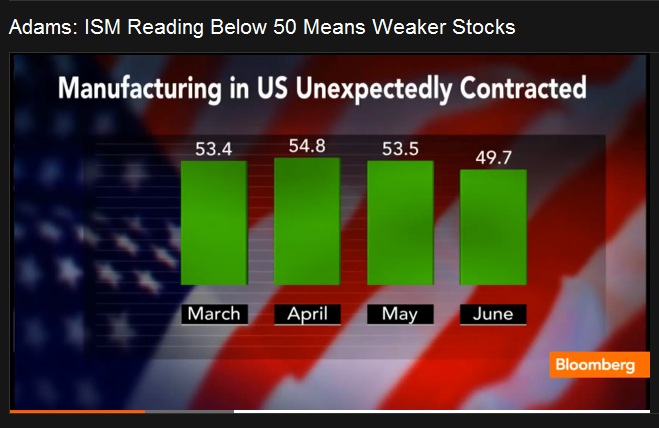
ISM Reading Below 50

Wells Fargo's Gina Martin Adams on the ISM

An Institute for Supply Management (ISM) Report reading below 50 does not mean the U.S. is in a recession, but the trend is not great.  Industrial stocks in the U.S. markets are weakening.  A continuation of the trend could signal a recession.  I find this interesting given the current trend for companies like Caterpillar which seem to be in the process of repatriating more jobs back into the U.S..  If that doesn't lead to growth in their manufacturing, then it makes me wonder what will?  Still, one reading below 50 does not a crisis make!

Like to volunteer your outlook? 

Wednesday, June 27, 2012

An Update From Harry Dent


Harry Dent's June 2012 Update

Canary in the Coal Mine
The major problem I experienced with the crash that resulted in the last Great Recession was that everybody was afraid to come out and tell the general public just how bad they thought things could get, with one exception.  I watched Mad Money with Jim Cramer on CNBC and one night he told his audience that if they had money invested in the stock market that they might need over the following five years, they should sell that portion immediately.  I did just that, but it was already too late.  While I did not lose as much as most people, it was still a big hit to my portfolio (i.e.: life savings).

The Media?
As it turns out, there were a number of people who came forward, later, to tell us what they knew and how things looked pretty bad to them, well before it actually happened.  The trouble is, what they were trying to tell people was not very popular at the time - certainly not with the broadcasting media.  As for the rest, do you think they would actually say anything to you and me, even if they suspected the worst? (That is where the term "whisper number" comes from - they'll say it to close allies, but not publicly).

Odds Are
Cramer took a lot of heat for telling people to sell.  Many in the industry called him irresponsible.  I appreciated the fact he had the courage of his convictions and was one of the few people I have ever heard actually telling people to sell.  The Buy and Hold types may scoff at the warnings, but as Mr. Dent says in this video, if things don't get as bad as he thinks it might, then worst case is we miss a little to the upside.  If he is correct, we miss a lot to the down side.  Any time I find myself in a situation with little chance of gain, and a huge chance for loss, I will gladly sit it out until the odds are more in my favour.

Technically Speaking
When do I get back in?  When the technical indicators say so.  I'll be one of the first to say when I see the technicals showing me a good re-entry point.  I am no investment professional, and can not advise others what they should do with their money.  Personally, I have been short, or out of this market, since before the year began.  I see no reason to change now.  For other peoples' sake I hope Mr. Dent is wrong, but right now, it just isn't a risk I am willing to take.

How do you see your chances?

Wednesday, June 20, 2012

Buy Energy Companies?

Click Here To Play The Video


John Manley from Wells Fargo talks about his liking energy companies.  He says he doesn't believe oil prices will go as low as people are predicting.  He also thinks oil will stay more expensive longer than people think, and that natural gas will stay lower longer than people think.  He especially likes big dividend paying energy companies.


Myself, I would like to see a break in the longer term down trend in energy stocks before I would buy.  The way I personally would play it is with the Horizons leveraged energy Exchange Traded Fund - HEU on the TSX.  These leveraged ETF's are only for shorter term trades, so if I wanted to hold it for longer term durations I would likely use the iShares Energy ETF (XEG).


How is your energy level?


Thursday, June 14, 2012


I am not really sure why I haven't posted anything here by Mr. Rogers prior to this.  From what I can tell he is one of the smartest people in the room.  His expertise is more in the area of commodities than equities, but that would make him an expert in commodity companies at the very least.

It would seem like common sense, but politicians and even too many economists believe the solution to too much debt is more debt.  Mr. Rogers disagrees.  He also talks about when the economic collapse will come, rather than if it will because of the snowballing debt world wide.  He states that competent people are supposed to be allowed to replace the incompetent ones who lost all their money.  Failing to do so, he says is "Absurd economics and absurd morality."  It reminds me of the author Stephen Covey who used to say we can't talk our way out of things we have (mis)behaved our way into.

Do you think Europe will survive intact?